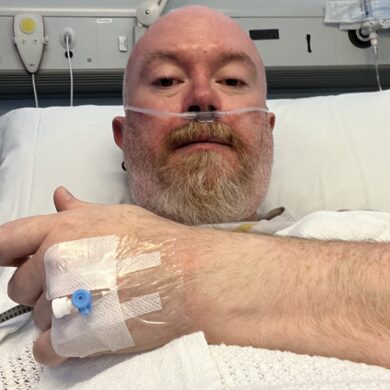
Simon’s story – acute pancreatitis
“If someone reads my story and recognises their own symptoms, or if it encourages them to ask about further investigations that could lead to an earlier diagnosis, then it’s worth it.”
Note: At Guts UK, we want our stories to be easy to understand for everyone. If any medical terms in Simon’s story are unfamiliar, you can find definitions in our medical glossary below.
Tell us a little bit about yourself
“My name’s Simon and I’m 49 years old. I moved to Liverpool 27 years ago and have lived here ever since. I’m a writer and have had children’s books published. Films are a big passion of mine and going to the cinema is one of the things that keeps me going.
I’ll also admit that when it comes to my health, I can be a bit of a typical bloke. If I’m ill, my first instinct is usually to think, “It’ll be fine, I’ll get through it.” Looking back, that probably wasn’t always the best approach.”

When did your first symptoms of pancreatitis begin and what were they?
“My first symptoms happened months before I recognised there was something wrong. I had a sudden pain just below my rib cage that lasted about an hour and left me with an upset stomach. Because it went away quickly, I didn’t think much of it at the time.
On 11 September 2025 at about 9:30pm, I was sitting at my computer doing some writing and suddenly, I felt like I’d been kicked in the stomach by the devil. The pain erupted just below my rib cage and was unbearable.
At first, I tried to power through it because I thought it was the same thing I’d had a few months earlier. After about two hours curled up on the bathroom floor, screaming in agony and vomiting, I finally called an ambulance. That decision led to my first hospital admission and, ultimately, my diagnosis of acute pancreatitis.”
Tell us about your hospital admissions with pancreatitis and journey to diagnosis.
“When I arrived at A&E, doctors carried out blood tests, scans and investigations before telling me I had acute pancreatitis. I spent eight days in hospital and had a CT scan and ultrasound, but they couldn’t find gallstones or any obvious cause.
Over the following months, I kept having flare-ups of symptoms. I was admitted to hospital seven times in total. By the end of January 2025, I’d spent 32 days in hospital.
Each time, the doctors treated the pain and carried out scans, but nobody could work out what was causing the pancreatitis. At one point it was even suggested that it might be idiopathic pancreatitis, meaning there was no identifiable cause.
The uncertainty was incredibly frustrating. The doctors wanted to help, but they couldn’t treat a cause they hadn’t found.”
Note: 8 in 10 cases of pancreatitis in adults are caused by either gallstones or excessive alcohol consumption. Gallstones are the most frequent cause of acute pancreatitis. The second most frequent is drinking alcohol above recommended limits.
Explain how the cause of your pancreatitis was identified.
“The breakthrough came during a hospital admission in January 2026. I was meant to have a scan of my liver, gallbladder, bile ducts and pancreas (an MRCP scan), but because I’m claustrophobic and struggled with the MRI machine, that wasn’t possible.
Instead, the team carried out an endoscopic ultrasound. That scan found microlithiasis which are tiny gallstones, sometimes described as “sludgy sand”, in my gallbladder. These were so small that they hadn’t shown up on the ultrasounds I’d previously had.
The doctors explained that these tiny gallstones and sludge were leaving my gallbladder and irritating my pancreas, which was causing the repeated pancreatitis attacks.
After months of not knowing, it was a huge relief to finally have an answer.”
What treatment did you receive for pancreatitis, including surgery?
“Now the cause had been identified, doctors were able to put a treatment plan in place. They recommended surgery to remove my gallbladder (a cholecystectomy), and I was placed on the waiting list.
I suffered another major pancreatitis attack, after going more than three months without an attack. I was on my way to a GP appointment when I felt the familiar pain starting again. I knew immediately what it was. An ambulance was called and I ended up back in hospital.
This admission turned into a two-week stay and included the worst pain I experienced. Because the cause of my pain was now known, they decided I wasn’t going home without having my gallbladder removed. What had been a planned operation on a waiting list became much more urgent.
I had the surgery in May 2026. It was my first major operation and, although I was nervous, the surgical team were fantastic. The procedure was done laparoscopically (through keyhole incisions), and my gallbladder was successfully removed.
While there is always a possibility that previous pancreatitis attacks may have caused damage to my pancreas, the cause of my pancreatitis has now been removed, so in theory it should never come back.”
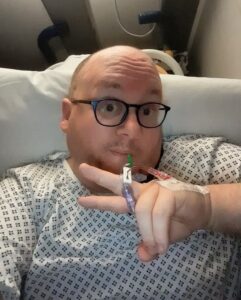
How are you now?
“I’m doing well. I’m still recovering from the surgery, but the wounds are healing and I’m feeling much better than I was.
I’m not on any specific treatment. I’ve got follow-up blood tests planned to make sure everything is progressing as it should, but overall, I’m optimistic.”
What do you wish others knew about the condition?
“I wish people understood just how painful pancreatitis can be. Before I was diagnosed, it was a word I’d heard before, but I had absolutely no idea what it was.
One doctor told me that pancreatitis causes some of the worst pain a human being can experience, and after going through it, I believe him. The pain is completely debilitating.
I also wish people knew that warning signs can appear before a major pancreatitis attack. Looking back, the pain I experienced months earlier was probably my body telling me something was wrong.
If you have severe pain under your ribs that leaves you doubled over, vomiting or unable to function, don’t do what I did and wait for hours hoping it will pass. Get medical help straight away.
And if doctors can’t find a cause, don’t be afraid to ask about more detailed investigations. In my case, standard scans didn’t show anything, but an endoscopic ultrasound found that tiny gallstones responsible.”

Why are you sharing your story with Guts UK?
“I’m sharing my story because people simply don’t know enough about pancreatitis.
Guts UK was one of the first organisations I found when I started looking for information and support, and they seemed genuinely committed to raising awareness of the condition.
If someone reads my story and recognises their own symptoms, or if it encourages them to ask about further investigations that could lead to an earlier diagnosis, then it’s worth it.
If my experience helps even one or two people avoid months of uncertainty, repeated hospital admissions and the unbelievable pain that pancreatitis can cause, then I’ll consider sharing my story one of the most worthwhile things I’ve ever done.”
Glossary of medical terms:
- CT Scan: A non-invasive test that takes detailed pictures of the inside of your body.
- Endoscopic ultrasound: Where a thin tube with a camera and ultrasound device on the end is inserted through the mouth to get accurate pictures of the tubes leading from the gallbladder and pancreas.
- Gallstones: Gallstones are small, solid lumps that form in bile. They usually cause no symptoms and most people with gallstones are unaware that they have them. However, in some people they can cause problems.
- MRCP scan: A non-invasive MRI scan used to visualise the liver, gallbladder, bile ducts, and pancreas.
- Ultrasound: A medical imaging technique which uses sound waves to create images of inside the body.