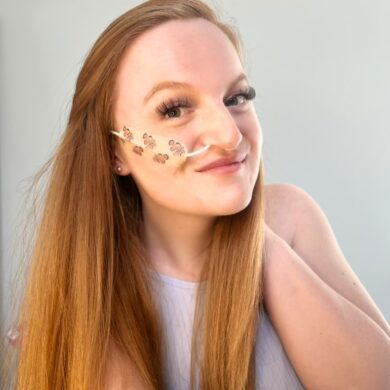
Bella’s story – Gastroparesis
“Don’t let it limit your life. Find ways around the things you want to do. And don’t give up on fighting for yourself. If you know something is wrong, speak to a doctor.”
Content note: This story includes discussion of eating disorders.
Note: At Guts UK, we want our stories to be easy to understand for everyone. If any medical terms in Bella’s story are unfamiliar, you can find definitions in our medical glossary below.
Tell us a little about yourself, Bella
“I love reading, poetry and art, and I currently study textiles. I love making clothes and have made dresses and jackets.
I used to be very sporty. I was part of a netball team and a hockey team, but athletics was my main sport. It was a huge part of my life. Unfortunately, because of my condition, my body can’t manage sports anymore.”

When did your symptoms begin, and what were they?
“Around March 2025. Before that, I had been living with anorexia nervosa for eight years and had been considered fully recovered. Then things started to change. At first, it was quite small things, like acid reflux, pain when eating and feeling full much more quickly. I went to the doctor and was prescribed omeprazole, but it didn’t really help.
Things gradually became worse. I was constantly nauseous and experiencing stabbing and burning pains. I would eat and then be sick hours later.
Because of my history, it was difficult to convince people that something else was happening. My psychiatrist believed me and pushed for me to be referred to gastroenterology.”
How long did it take to get your diagnosis?
“It took quite a while. Initially, the NHS wouldn’t accept my referral, so I had my investigations done privately. Once they found something, I was referred back to the NHS.
On the NHS, I had an ultrasound, which was clear, and I was discharged. But my symptoms continued to get worse. I was vomiting more frequently and losing weight. Eventually, I saw a gastroenterologist privately.
I had an endoscopy and, despite having fasted beforehand, there was still food in my stomach. There was also some food in my oesophagus. The biopsies were clear, but the findings suggested delayed gastric emptying.
I then had further tests; the results showed that the contents of my stomach were moving extremely slowly. That was how I eventually received my gastroparesis diagnosis, at the end of December 2025.

How did you feel when you received your diagnosis?
“It was very mixed emotions. It’s obviously not nice to be told that you have a chronic condition, but at the same time I felt an enormous sense of relief.
I remember looking at my scan results and thinking, ‘I knew I wasn’t going crazy.’ I could actually see that the barium had barely moved from my stomach after several hours.”
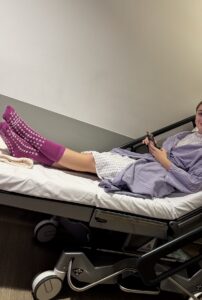
How has gastroparesis affected your everyday life?
“I can only manage very small amounts of food, and I’m still mainly reliant on nutritional supplements. I also struggle with fluids. I can’t drink a normal glass of water. I might only be able to have a couple of sips every 15 minutes. Summer is particularly difficult because I can’t keep enough fluids in me.”
What things help you?
“I try to get some gentle exercise when I can, like going for a small walk with my dad. I also find that creative things like reading, drawing and writing help. I’m really grateful that these things bring me joy. They don’t take the pain away, but they give me something else to focus on.
I’ve had to learn that I need to keep myself busy, but not to the point of completely exhausting myself. It’s about finding a balance.”
What treatment are you receiving?
“We’re looking at possible future treatment options. Surgery has been discussed, including G-POEM, although I have to wait until I’m 18 before this can be considered for me. I’m scared of surgery, naturally, but I’m also hopeful. I want to go to university next year, study medicine and be able to enjoy that experience.”
Note: G-POEM is a treatment that is not widely available, and the research evidence is currently limited. More research is needed before it can be recommended routinely.
What would you say to someone who has just been diagnosed?
“Sometimes when you get a diagnosis, it can feel like the end of the world. But it’s not.
It does limit some of the things you can do, but don’t let it limit your life. Find ways around the things you want to do.
I know that not everyone has the opportunity to go privately, and I recognise that I was very fortunate to be able to do that. But keep asking questions, ask for a second opinion, and keep advocating for yourself.”

Why are you sharing your story?
“A lot of digestive conditions are so unknown. Most people have heard of IBS or Crohn’s disease, but I had never even heard of gastroparesis before I was diagnosed.
It’s not just the person with the condition who needs to know about it. Family members and other people need to understand these conditions too.
I think there needs to be more awareness and recognition of these less well-known conditions, and I think Guts UK does a really good job of educating people about them. When I was diagnosed, my gastroenterologist told me about the Guts UK website. It was really helpful to understand what gastroparesis was and what was happening to me.
I then followed Guts UK on Instagram and saw other people sharing their stories. That made me realise that I wasn’t alone. I hope sharing my story helps other people feel less alone.”
Glossary of medical terms
- Barium meal test: this involves drinking some barium liquid, which will show up your oesophagus, stomach and first part of the small intestine on x-ray
- Biopsy: a small sample of tissue
- Delayed gastric emptying: when food or liquid takes longer than expected to leave the stomach.
- Endoscopy: a thin tube with a small camera on the end, inserted via the mouth to look inside the body.
- Gastroenterologist: a healthcare professional who specialises in the diagnosis and treatment of conditions affecting the digestive system
- Gastroenterology: the branch of medicine where healthcare professionals focus on the digestive system
- G-POEM surgery: a procedure that relaxes the muscle at the bottom of the stomach, helping food and drink pass more easily into the small intestine.
- Omeprazole: this is an acid-suppressing medication which reduces the amount of acid produced by the cells in your stomach.
About Guts UK
Guts UK is the national charity for the digestive system and the only UK charity funding research into the whole digestive system.
We provide information and support for people affected by digestive conditions, including a dedicated Helpline.
Beat
Beat – the UK’s eating disorder charity offers information and support for people affected by eating disorders, as well as family and friends.
Beat Helpline (England): 0808 801 0677
Opening hours: Monday–Friday, 3pm–8pm
Email: [email protected]
We are sharing this information because we recognise that digestive conditions and eating disorders can sometimes overlap in people’s experiences, and we want people to know where they can find specialist support.