Annie’s story – Diverticular Disease
“No matter how bad it gets, there is light at the end of the tunnel.”
After years of living with diverticular disease and repeated flare ups, Annie became seriously unwell and needed life-saving surgery and a temporary stoma. Almost three years since her last flare up, Annie is feeling really positive about the future and is sharing her story to give hope to others living with diverticular disease and show that things can get better.
Note: At Guts UK, we want our stories to be easy to understand for everyone. If any medical terms in Annie’s story are unfamiliar, you can find definitions in our medical glossary below.
Tell us a little about yourself, Annie
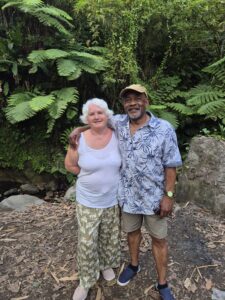
“I’m 67 and I live at home with my husband. I’ve got two daughters and he’s got two sons, so we’re a lovely blended family, with everyone dotted about the country. My husband’s mum is still alive, so it’s great to have family around us.”
When did your symptoms begin and what were they?
“I always had a weird pain for as long as I can remember, and then I started having attacks of diverticulitis over many years. I eventually got my diagnosis in 2006.
I also noticed that certain things seemed to trigger my attacks. Over time, I became much more aware of my body and the things that seemed to upset my bowel. I started to notice patterns around certain foods and drinks, and I learnt that avoiding some of these things helped me manage my symptoms.
I’ve become much more careful about looking after my bowel and paying attention to how I’m feeling.”
What treatment have you received for diverticular disease?
“My doctor was always happy to prescribe antibiotics when I had an attack. I know doctors don’t always have the same view about antibiotics, but I had experienced so many attacks that I really knew when one was happening.
Eventually, I became so poorly that I needed surgery. I ended up having an operation for a perforated bowel and sepsis (which gave me a temporary stoma) in 2020. I feel very lucky because I could have died.
Looking back, I feel that when I ended up very ill and had to have the operation, I didn’t take things seriously enough. That experience has really stayed with me.
It’s made me much more aware that if I start to feel unwell, I shouldn’t just put it down to something else or hope it will go away.”
How are you now and how does diverticular disease impact your everyday life?
“I’m actually doing really well now. It’s coming up to three years since I’ve had an attack. I have a scar from my operation. I don’t mind it at all because it shows what I’ve been through.
I genuinely feel good, and I think a big part of that is having learnt to understand my bowel and what makes it happy or unhappy. Being careful and paying attention to my body has made a real difference for me. I’ve also learnt about inflammation and how important it is for me to try to keep on top of that.
I’ve also found support through a Facebook group for people with diverticular disease and that’s where I found out about Guts UK. It’s helped me understand my own condition better and feel less alone in it.”
What does living well with diverticular disease look like?
“For me, it’s about raising your awareness of your body and what upsets it. I think you have to learn what makes your bowel happy and give it the best chance of staying that way.
But if you are in hospital with complications, it can be very different. The doctors advised me to give my bowel a rest and have a low-fibre diet till I recovered from my surgery. Obviously, everybody is different, but if you find something that works for you, then absolutely do it.”
There are those practical things, but I think being aware of your bowel and whether it’s happy is really important.”
A note about diet: Everyone’s experience of diverticular disease is different, and there is no one-size-fits-all approach to diet. If you’re struggling with your diet or are unsure about what foods are right for you, speak to your doctor or another healthcare professional. They may be able to refer you to a registered dietitian for personalised advice.
Is there anything you’d say to someone with digestive symptoms or conditions?
“Don’t take the risk. If you’re getting attacks or infections, go and see your doctor. You need to trust your body, don’t put it off. If you start to feel unwell, particularly if you feel a bit flu-like, shivery or hot, take that seriously.
And I think you need to lean on people when you need to. Don’t try to suffer on your own, either with the illness or with the effects of what has happened. People are there for you to lean on, and then when you get better, they can lean on you.”

Why are you sharing your story today?
“I think what prompted me to share my story was the feeling that, no matter how bad it gets, there is light at the end of the tunnel. I feel so positive.
I learnt to say to myself, ‘That’s what this day looks like. Tomorrow might be different. It might be better.’ That was a really good philosophy for me.
I think that’s something I’d really like people to take away from my story. Even when things feel incredibly difficult, it doesn’t mean that’s how things are always going to be.”
Glossary of medical terms
- Diverticulitis: this happens when one or more diverticular pouches get inflamed or infected. This can cause increasing pain and other symptoms.
- Stoma: where a section of bowel is brought out through an opening on the abdomen.
About Guts UK
Guts UK is the national charity for the digestive system and the only UK charity funding research into the whole digestive system.
We provide information and support for people affected by digestive conditions, including a dedicated Helpline.