Beverly’s Story – Biliary Sphincter Disorder
Diagnosed with biliary sphincter disorder after gallbladder surgery, Beverly shares how she navigates chronic pain, treatment challenges, and life beyond her condition.
Note: At Guts UK, we want our stories to be easy for everyone to understand. If any medical terms in Beverly’s story are unfamiliar, you can find definitions in our medical glossary at the bottom of this page.
Tell us a little about yourself
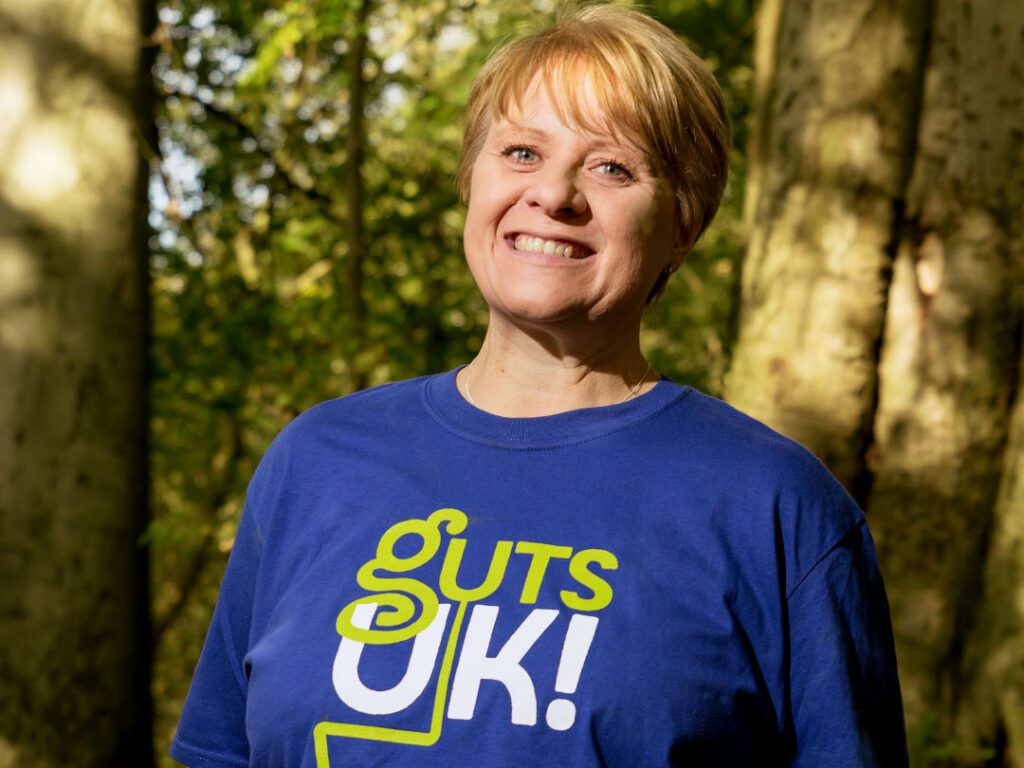
“I’m Beverly. I was born in 1964, and I live near Lincoln with my husband, Graham. I used to work as a veterinary nurse, which I loved until I became ill and had to step away. I love writing pen pal letters for Age UK and people impacted by cancer. I also love reading non-fiction, especially biographies or anything I can learn from.”
When did your symptoms begin, and what were they?
“It all started back in 2005. At the time, I was working extra shifts and had been feeling under the weather and tired for several months. I assumed I had just overdone it with work and home life.
One day, while in my local supermarket, I suddenly slumped over the shopping trolley. Graham was elsewhere in the store, but people around me stepped in to help. I’d turned grey, felt an excruciating pain in my upper right abdomen, which continued to get worse. At the time, the whole experience felt more embarrassing for me than scary. I came around, and Graham took me to A&E.
After several tests, doctors found that my gallbladder was infected. I’d never had pain there before, and it all seemed to be a big build-up that suddenly happened. I was scheduled for emergency keyhole surgery to have my gallbladder removed.”
Talk us through your journey to diagnosis
“Initially, after my operation, I felt so good. I’d lost a lot of weight, felt full of energy and really well. But about eight months later, I started feeling sluggish and poorly again.
I remember waking up one morning for work, creeping around in the dark so I wouldn’t wake Graham. When I got into work, a colleague took one look at me and asked me if I was okay, saying I looked yellow. Because I was wearing a green uniform, I hadn’t recognised at first, but even my eyes were yellow. Someone took me straight home, and I saw my doctor.
My doctor sent me straight to hospital, where I spent the next two and a half weeks. I lost an unhealthy amount of weight, but I didn’t get a diagnosis during that stay.
It took several months after that to get answers. We lived in Liverpool at the time, and thankfully, my doctor there was very familiar with biliary sphincter disorder. During an Endoscopic Retrograde Cholangiopancreatography (ERCP), they saw that my bile duct was over-contracting, and I was diagnosed with Type III SOD. With Type III, it doesn’t always show up in my blood tests, but if my liver markers are high, an attack will usually hit within five to seven days. On days where I have an attack, I experience severe pain in my upper abdomen that radiates through to the top of my back, and I often vomit.”

How did your diagnosis make you feel emotionally?
“Initially, I found it really hard, especially because of how unreliable it made me feel, whether that was at work, with family or with general life plans. My boss kept my job open for a long time, but eventually, I had to make the decision to step away. You come to a point where things have to change, and you have to cut your cloth accordingly.
My family have been amazing through it all. Over the years, seeing a psychologist has helped me a lot to process everything. After so many years, you learn to accept it as a reality and figure out how to work with it. We adapt our plans around it. Sometimes things fall by the wayside, or if I only have the energy to put the slow cooker on for meals, that’s what I do.”
What treatment have you had?
“Finding the right treatment has been a long journey. Over the years, I tried many different medications, and some didn’t suit me at all mentally. Some caused personality changes, making me quiet, calculated, and easily annoyed, which made my general ability to function worse. I remember Graham asking me after a few weeks if the medication was actually helping. One day, I was making a pot of tea, and when the kettle boiled, I realised I had no idea what to do next. Coming off those medications allowed me to feel like myself again.
Today, I take a much simpler variety of prescribed treatment: anti-spasmodic medication, soluble paracetamol, anti-sickness medication and very small doses of morphine when needed.”
How does biliary sphincter disorder affect your everyday life and how are you now?
“It has been incredibly tough at times. Managing chronic pain and finding the right medication has been a challenge. There’s no ‘one-size-fits-all’ approach.
I’ve always been a ‘glass half full’ person, and I’m blessed with good mental health. But my condition has robbed me of my ability to work, my spontaneous nature and my sparkle. That is a high price to pay. Even though I can’t hold down a regular job, I like to apply myself in other ways such as writing letters and helping Graham with his photography business.
Outside of my biliary condition, I also reached a point pre-Covid where I had put on weight and consequently, developed high cholesterol and high blood pressure. I now realise how important it is to look after my general health. I focus on keeping my weight healthy, staying active with gentle walking when I am able and eating a low-fat diet, which really helps keep things managed.”

Why did you want to join Guts UK’s Expert by Experience (EBE) panel, and what does it mean to you?
“Initially, I reached out to Guts UK just looking for information. Following that, I was invited to join the EBE panel and interviewed. Even though I didn’t have a medical background, Guts UK reassured me that my lived experience is what matters.
Being part of the panel has been a wonderful experience. It has given me an opportunity to apply myself alongside people who truly understand. I love listening to other people’s stories and learning about different digestive conditions and the perspectives of people who support those impacted. The fact that meetings are hosted online makes it completely accessible for me.”
What do you wish other people knew about digestive conditions such as biliary sphincter disorder?
“I wouldn’t wish this condition on anybody, but I want people to know that it’s okay to ask someone about their condition, it doesn’t define us! There is so much more to me than my condition.
I also wish people understood that when I say ‘no’ to certain foods, I mean it. People often say, ‘just one won’t hurt you’, but it really will, and I have my reasons I shouldn’t have to explain.
When it comes to breaking the stigma around digestive health, there’s a time and a place. I don’t need to dominate every conversation with talk surrounding bowel habits, but we shouldn’t be afraid to talk about it openly when it’s appropriate.”
Why are you sharing your story today?
“More awareness, resources and research are desperately needed. So many people have little to no knowledge of what biliary sphincter disorder is or how to treat it.
When you live with a chronic illness, there comes a point where you have to accept that it’s a major part of your life. I like to nip things in the bud – ignoring any grumble or symptom is never a good idea, so always get checked out.
Acceptance is key. We all go through stages of thinking ‘Why me?’ or wondering what we did wrong years ago, but once you reach acceptance, things start to even out. Chronic illness is like a relationship you constantly have to work on, as you can’t walk away. It’s about celebrating the little wins and victories, finding ways to manage your condition and living your life as well as you possibly can.”
Glossary of medical terms:
- Anti-spasmodic medication: Medication designed to relieve or prevent muscle spasms in the digestive tract, helping to ease cramping and pain.
- Bile duct: A small, tube-like structure that carries bile from the liver and gallbladder into the small intestine to help digest food.
- Biliary sphincter disorder: A condition affecting the Sphincter of Oddi, which is a muscular valve that controls the flow of digestive juices (bile and pancreatic juice) into the small intestine. When this muscle spasms or does not open properly, it can cause a backup of digestive juices and lead to symptoms such as severe abdominal pain.
- ERCP (Endoscopic Retrograde Cholangiopancreatography): A procedure which combines X-ray imaging and an endoscope (a long, flexible tube with a camera on the end passed through the mouth) to examine the tubes or ducts that carry bile and pancreatic fluid, allowing doctors to diagnose and treat problems in those areas.
- Gallbladder: A small, pear-shaped organ located beneath the liver that stores bile produced by the liver until it is needed to help digest fats.
- Liver markers (liver function tests): Blood tests that measure specific enzymes and proteins to check how well the liver is functioning. Elevated markers can indicate inflammation, stress on the liver or even a blockage in the biliary system.
About Guts UK
Guts UK is the national charity for the digestive system and the only UK charity funding research into the whole digestive system.
We provide information and support for people affected by digestive conditions like biliary sphincter disorders, including a dedicated Helpline.