Amar Srinivasa
Project: "Investigating the Causes of Post-Endoscopy Gastrointestinal Cancer (PEUGIC)."
Medical Student Prize Winner 2025
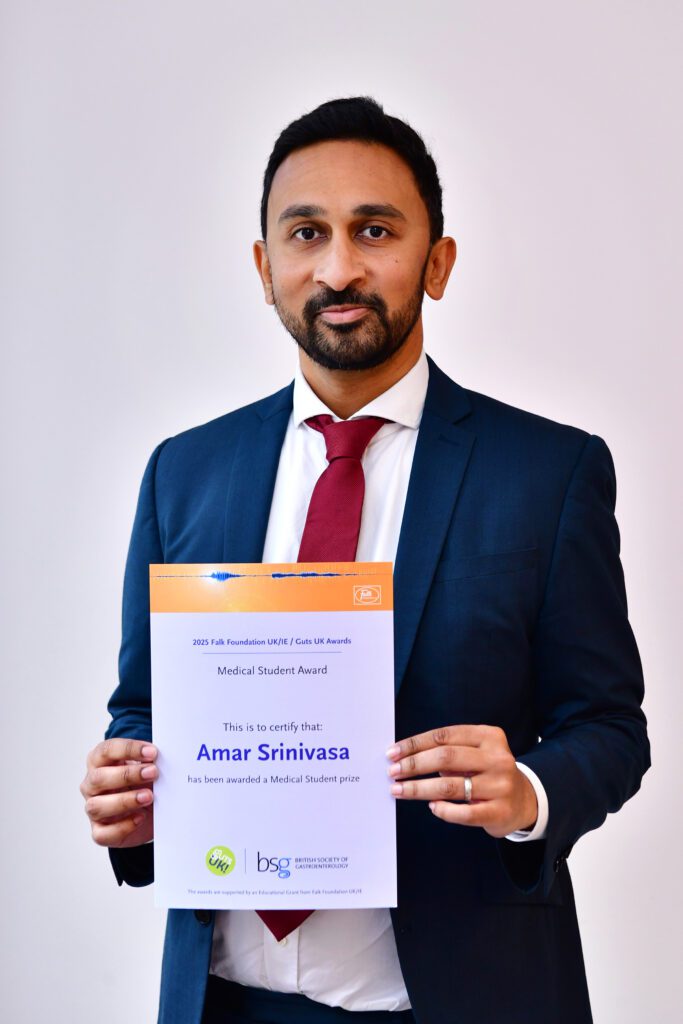
Dr Srinivasa explains:
“Endoscopy, a key diagnostic tool for oesophageal and stomach cancers — two of the six least survivable cancers — is crucial for early detection. If caught early, these cancers can be cured through minimally invasive endoscopic procedures, sparing patients from extensive surgery and arduous chemotherapy.
However, endoscopy is not infallible. Some patients receive a cancer diagnosis despite having previously undergone endoscopy that failed to detect their condition — this is classified as PEUGIC. Such diagnostic delays can profoundly adversely impact patient outcomes.
Existing studies on PEUGIC have identified risk factors but have not fully explained its causes. Notably, 8.5% of oesophageal and stomach cancers fall under the PEUGIC category. However, without national datasets, identifying affected patients and enabling endoscopy providers to improve their services remains challenging. To address this, our study aimed to:
- Establish a national system within NHS England to identify every PEUGIC.
- Notify endoscopy providers about their PEUGIC.
- Develop an online portal for providers to conduct root cause analyses, helping them understand why PEUGIC occurs.
- Pool national data to pinpoint reasons behind PEUGIC and inform interventions to reduce their occurrence.

At the conclusion of the study, over 2,500 PEUGIC were analysed, making this the largest global cohort of post-endoscopy cancers ever studied. The findings highlight two major patient groups with differing causative reasons for PEUGIC.
In symptomatic patients undergoing diagnostic endoscopy, we found that squamous cell oesophageal cancers are frequently missed and that many lesions with potential malignancy are not biopsied sufficiently, leading to diagnostic failures. Utilisation of image enhancement technology available in modern endoscopes could prevent missing these cancers and to improve biopsy practice I have authored the National Upper Gastrointestinal Endoscopy Biopsy Guidance Document, designed to standardise biopsy practice.
The second group of patients were those undergoing surveillance endoscopy due to conditions associated with increased cancer risk (eg Barrett’s oesophagus). Here, the study underscores that non-adherence to best practices significantly compromises patient outcomes.
This overarching body of work represents the largest evidence base for PEUGIC and associated patient, procedural and provider factors that contribute to its occurrence. By identifying practices which contribute to PEUGIC, national interventions can be commenced to decrease their occurrence and improve cancer outcomes. Additionally, this study provides a significant evidence base which can be used for best practice guidelines for upper gastrointestinal endoscopy nationally and internationally. Finally, this study will be linked to the National Endoscopy Database during the final year of my PhD with the goal of creating evidence-based key performance indicators for endoscopy.”
What did it feel like to win this award?

I am immensely grateful to have been part of this project, working under the mentorship of Professor Nigel Trudgill, who has played a pivotal role in shaping my career in gastroenterology. This study was a collaborative effort, and its success would not have been possible without the contributions of numerous colleagues across the country.
Receiving this prestigious recognition will enhance the dissemination and impact of our work. I hope it drives improvements in endoscopy practices both nationally and internationally, ultimately benefiting patients diagnosed with these cancers.
Read more about Dr Srinivasa’s project, focused on the gut, by downloading the PDF below.