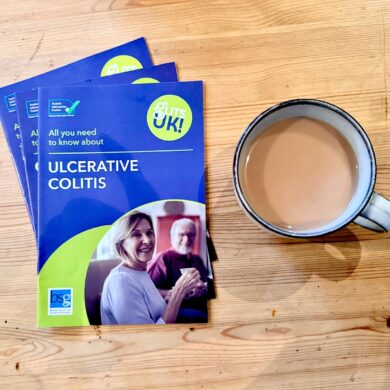
Sean’s story – Ulcerative colitis
"Some people think it’s just a bad tummy or pain when you go to the toilet, but it’s much worse. It can feel like your whole body is hurting."
Tell us a bit about yourself
“I’m Sean, I’m 35 years old and live in Hartlepool. I have two children, a 5-year-old daughter and a 7-year-old son, and we have a golden retriever named Mikey. I enjoy going to the gym, playing airsoft, video games, and spending time with my partner, Rachel.”

When did your symptoms start, and what were they?
“In my early 20s, I started experiencing abdominal pain before needing to go to the toilet. This increased to pains whilst using the toilet to poo, and then I noticed blood. It began as pain in my bowels, but then became a full-body ache that drained the energy out of me.”
What happened next?
“I was originally diagnosed with haemorrhoids (blood vessels inside the anus that have become more swollen or have small tears) and was advised to try suppositories and topical creams (cream applied directly to the affected area) to treat them, but the pain continued to worsen. After a few weeks, I went back to my GP who eventually booked me in for a colonoscopy and a biopsy (a colonoscopy is a thin tube with a small camera on the end inserted via the back passage, and a biopsy is a small sample of tissue). This revealed ulcerative colitis.
I was prescribed steroid-based medication and incorrectly assumed this would be a cure, and it was a one-off thing. It was only when the symptoms reoccurred that I was told this was a disease with no cure. The medication is lifelong and can only help to reduce and minimise the symptoms, but ‘flare-ups’ could still occur.
Things continued to get worse, and I had another flare-up (worsening of symptoms). I was prescribed antibiotics, steroids, iron and calcium tablets. I was also prescribed topical treatments (medications applied directly to the affected area of the colon via the back passage) that were sometimes more painful than the condition itself but helped to reduce the effects.”

How did it feel to be diagnosed with ulcerative colitis?
“It was horrible. At first, I thought it was a stomach bug or something that would go away, but when I found out it was something I had to live with forever, it took over my life. I managed to live life as normal and still enjoy my hobbies, but days and nights out with family and friends revolved around my knowledge of accessible toilets.”
Are there any hospital experiences that you remember in particular?
“I became very ill in the early months of 2016. I began to rapidly lose weight and noticed my skin started to become yellow in colour. I was taken to hospital and told I was no longer responding to the original medication. The inflammation in my bowel had caused further issues and was affecting my liver. I was given an infusion of a stronger medication and was told I’d need to have the medication as a monthly infusion.
Unfortunately, after only a few days, I was rushed back to hospital and told that I was beyond the help of medication. Doctors told me that I’d need surgery to form a permanent ileostomy (a surgical procedure that creates an opening from the small bowel to divert the contents through the abdominal wall into a medical bag) and that it was my only option. Without it, I would likely die.
Within a week, I went from a change in my medication to becoming permanently disabled.”
How are things for you now?
“I am incredibly lucky that the surgery was a success, and I live comfortably with an ileostomy. For me, it was the best outcome as I am no longer in pain and can now live a more ‘normal’ life. I am very fortunate to have friends and family close by to keep my spirits up and help me adjust to my new life.
Since my surgery, I have had two amazing children, become a homeowner, and worked in more successful and fulfilling jobs. Without my ileostomy, I would have struggled to do all of this.”

How does your digestive condition affect your daily life, and how do you feel now?
“After having the surgery, life has improved significantly. I no longer suffer from different foods or experience pain when going to the toilet. It’s not perfect and still has its issues, like going swimming with my kids – it’s more of a planned event, and I need to keep spare supplies for my bag for afterwards. But I would take that over the pain I used to feel.”
What is one thing you wish people knew about ulcerative colitis?
“When I first had symptoms, I was living with my brother, and although he is a loving and supportive brother, he couldn’t grasp how badly it affected me until things got much worse. Some people think it’s just a bad tummy or pain when you go to the toilet, but it’s much worse, and it can feel like it’s hurting your whole body.
Be patient and as understanding as you can with someone who might be suffering from a digestive condition like ulcerative colitis. They are trying their best and don’t want to feel like a pain to others.”
Is there anything else you’d like to share?
“To anyone going through this: I know it’s scary, and I know you are in pain, but listen to the doctors and do everything you can to not only take care of yourself but try not to let the disease control your life. If the path of your treatment takes you down the route of needing a stoma, such as an ileostomy, don’t worry – it really is nowhere near as bad as you imagine, and for most people, it can give them more of their life back. Look for support groups locally and online – there are people already asking the questions you might feel too embarrassed to ask. You can get help without judgment. You’re not alone, and you can get through this!”
About Guts UK
Guts UK is the national charity for the digestive system and the only UK charity funding research into the whole digestive system.
We provide information and support for people affected by digestive conditions like ulcerative colitis, including a dedicated Helpline.
With your support, we can be there for people when they need us most. Please consider making a donation to Guts UK today.