Alex’s story – Microscopic Colitis
"I knew what was going on with my body wasn't 'normal', but when your tests don't have a name for it, you feel like you're losing your mind."
Tell us a little about yourself
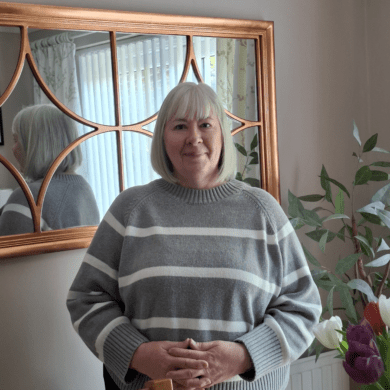
“My name is Alex. I’m 61 years old and live in Oxfordshire. I work as a deputy manager for a mental health unit. I love mountain biking, gardening, walking and going on holidays, and I enjoy spending most weekends with my partner of four years.”

Can you describe when your symptoms started and what they were?
“It all started in January 2022 with watery diarrhoea five to seven times a day. I lost weight rapidly, felt fatigued constantly, and became dizzy or breathless when out on my bike. I lost half a stone in weight quickly, which was a terrifying sign. My stomach would make these incredible, loud, gurgling sounds, and it was quite embarrassing as people would ask, ‘Is that your stomach?’
I had a lot of tests done by my GP, including blood work and testing stool samples, but everything came back normal. I was told to take anti-diarrhoeal tablets, but they didn’t work, and I was still in a lot of pain.”
Talk us through your journey with microscopic colitis
“In December 2022, I was referred for a colonoscopy (a thin tube with a small camera on the end inserted via the back passage). In January 2023, my GP called me into the surgery. She explained they had found microscopic colitis in the lining of my colon.

I started a course of steroids, Budesonide, starting at 9mg and tapering down to 3mg. While it helped at first, the flare-ups returned as soon as I stopped. This became a repetitive cycle throughout the past few years. After another colonoscopy in October 2025, I met with a consultant in January 2026. We decided I would take a 3mg maintenance dose every day for a year. As I also have a kidney disease, it’s a delicate balancing act, ensuring my treatment for one condition doesn’t upset the other.”
How did this impact you emotionally?
“I knew what was going on with my body wasn’t ‘normal’, but when your tests don’t have a name for it, you feel like you’re losing your mind. When you’re losing weight rapidly, and nobody can tell you why, you naturally worry it’s something like cancer. Even when the screenings come back negative, you still worry because your stomach is making noises and you can’t keep any food in you. That’s when the anxiety sets in – not just about the next accident, but about the unknown.
I remember being on holiday with my partner earlier on in our relationship, and I had an accident in the middle of the night. He was fast asleep, so I cleaned it up and hid the sheets as best I could. I didn’t tell him for a long time!”

How are you now?
“I’m managing much better now that I have a stable plan. When my consultant asked if this condition had affected my life, I told him: ‘Greatly’. It has changed my relationship with food. He noted how well-read I had become on the condition. I now stick to a balanced diet, eating little and often. I’ve learnt that hydration is key and to limit alcohol. I still enjoy life, but it’s about making careful choices to keep the symptoms at bay.”
What is one thing you wish people knew about microscopic colitis?
“The reality of living with this condition means accepting things that are uncomfortable. You cannot just ‘hold it’. I’ve had loads of accidents, and you have to learn to manage them. You always carry spare knickers and tissues, and you are constantly checking for the nearest toilets. It’s about being prepared for that unpredictability so you can still live your life.
My advice is to get checked out immediately. You need that peace of mind. Getting a diagnosis allows you to stop worrying about what is happening and start learning how to regain some control over your day-to-day life.”

Why are you sharing your story?
“I’m sharing my story because when you first experience these symptoms, you are totally in the dark. You might think it’s just something you’ve eaten, but when it carries on for weeks or months, it’s not normal.
If someone reads this, they might feel empowered to ask their doctor to check them properly. I’ve spent a lot of time researching information to understand how to manage this condition, and I hope that by speaking out, I can help others find clarity sooner and regain control of their lives.”
Why do you support Guts UK charity?
“I found Guts UK when I was looking for answers. Having a source of trustworthy information is vital for managing this condition. I’m now taking part in medical research, looking at ways to better treat and manage the symptoms.”
What are your hopes for the future?
“I’m hoping for a cure. I want to help the next generation who have to deal with this, so they don’t have to go through the same long journey I did. I know that someone reading this may be newly diagnosed or still searching for an explanation for their symptoms. I hope that by sharing my story and supporting research, I can help others find a way forward.”

About Guts UK
Guts UK is the national charity for the digestive system and the only UK charity funding research into the whole digestive system.
People are suffering. People are dying. All because of a lack of knowledge about our guts. Guts UK exists to change that.
With new knowledge, we will end the pain and suffering for the millions affected by digestive diseases. Please consider donating today. Your donation will help fund research leading to earlier diagnoses, kinder treatments and ultimately, a cure.