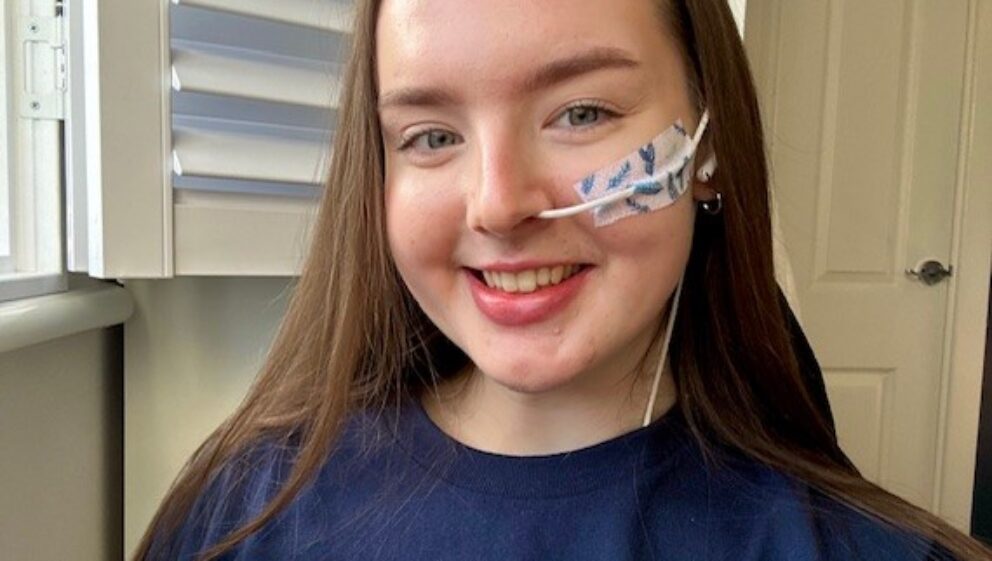
Guts UK supporter, Lucy, shares her gastroparesis story to raise vital awareness
Posted: 18th August 2025 Updated: 17th November 2025
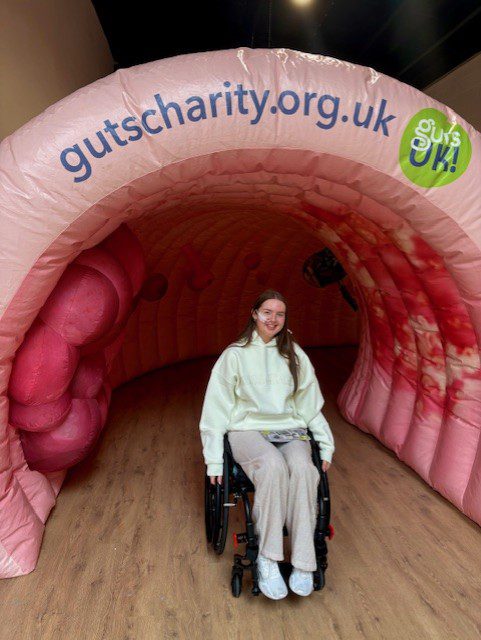
We love to meet Guts UK supporters face-to-face wherever possible. In June, our team was in Glasgow raising vital awareness of digestive health conditions and symptoms at The Forge shopping centre, alongside Colin, the giant inflatable colon.
Having seen a social media post about our road trip to Glasgow with Colin, Guts UK supporter, Lucy, and her mum, came along to meet our team and chat about how our charity has supported her to get to grips with her diagnosis ofgastroparesis.
We caught up with Lucy a few weeks later, ahead of Gastroparesis Awareness Month in August, to talk about her experience of living with the condition.
Lucy is 19 and is from just outside Glasgow. An avid music fan, when we met Lucy, she was excited about attending a Lana Del-Ray concert later that evening. Looking forward, Lucy is currently enjoying her summer break ahead of starting University in Glasgow to study Politics and International Relations.
Talking about her gastroparesis diagnosis, Lucy explains that after living with the autonomic nervous system disorder, PoTS (Postural orthostatic tachycardia syndrome), which was diagnosed at age 14, Lucy’s initial gastroparesis symptoms, which included nausea and extreme abdominal pain, were thought to be linked to PoTS as the condition can affect the stomach. In the summer of last year, Lucy’s symptoms worsened, and she was admitted to hospital.
“When I was admitted, I had low blood sugar. I was nauseous and I just kept throwing up. I was struggling to keep anything down and had excess saliva. It was put down to a virus because I had a high temperature, but the symptoms continued after I was discharged.
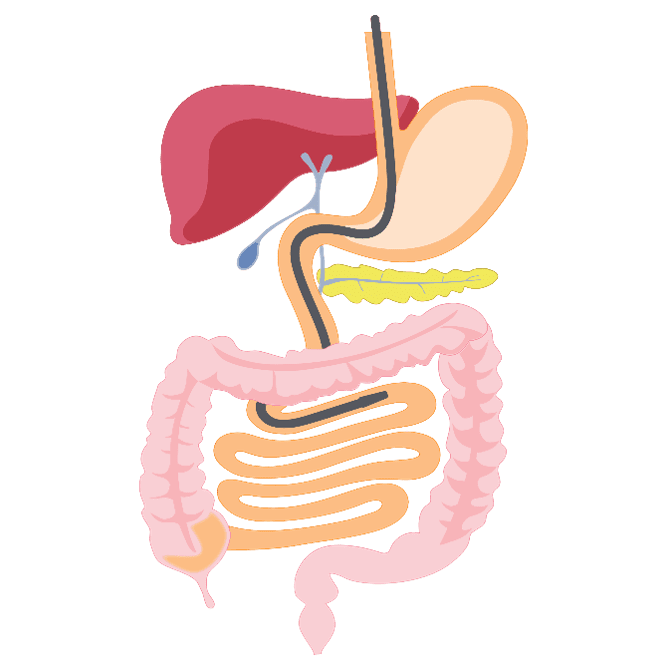
“After going back and forth to the GP, gastroparesis was mentioned as a possible connection to PoTS because they can both co-exist. I had such severe stomach pain and needed stronger pain relief, so I was then sent for testing. I had an endoscopy (a thin tube with a small camera on the end inserted via the mouth), which came back normal. Then I had the gastric emptying study (a medical test that tracks how long it takes a meal (or drink) to move through your stomach and empty from it) which was prolonged, and that’s when I got the diagnosis of gastroparesis.”
A diagram showing an endoscopy (tube down the throat) to look into the digestive tract.
Before her diagnosis, Lucy had never heard of the condition and what living with gastroparesis would involve.
“Guts UK was the first charity I came across when I was looking at information about the condition. The website explained gastroparesis in a really simple way, and there were pictures showing how food goes into your stomach and gets stuck, which made it easier for me to learn about it.
“I also read a woman’s story, which connected a lot with mine. Although I saw she had a feeding tube, which I hoped I would never need. It was nice to see someone else with the condition, knowing that it wasn’t just me, especially because she was close to my age.”
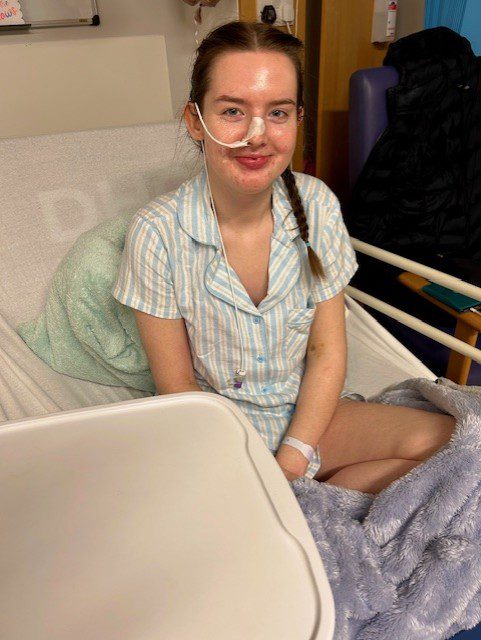
Lucy’s initial treatment involved dietary changes, medication and nutritional supplements; however, after experiencing extreme weight loss, low blood sugar, nausea, and vomiting, she was admitted to hospital in the new year of 2025. Lucy recalls the moment she was told she would need an NJ feeding tube (a tube which is inserted through the nose to provide nutritional support. Food is directed straight into a part of the digestive system via the tube instead of the mouth.)
“There wasn’t really a choice with getting the tube; I was barely able to speak and move in the hospital bed because I was so exhausted and weak. I just remember crying, I didn’t want a feeding tube at all. I was really scared, and I didn’t know anyone who had one. I thought a feeding tube meant I was going to be in the hospital all the time, which I’ve realised now, it doesn’t mean that at all.
“Everything happened over a weekend, so I had time to think about it before the final decision was made on Monday. At this time, I reached out to a few people who had them, and they spoke to me and told me it’s helped them a lot.
“Reflecting now, I would say to anyone going through a similar experience to embrace the tube and go with it. It was a hard thing to process, I think, because when I was first diagnosed, it wasn’t in my head at all that I would have a tube.”
Lucy’s NJ feeding tube goes to the start of her small intestine and bypasses her stomach, which is affected by her gastroparesis. Her tube is connected overnight and runs for around 13 hours, with Lucy commenting she can set it up quickly, in around three minutes.
Lucy is still able to enjoy small amounts of food and drink, including cups of tea. She confesses she loves sweets, but chewy ones can get stuck on her tube, with boiled sweets being a better option. When eating out, mashed potatoes are a firm favourite due to their consistency, with her friends and family always checking ahead to make sure it’s on the menu.
Talking about life after her feeding tube, Lucy said:
“I have so much more energy. Even after a week of starting the feeds, I just felt so much more like myself. My weight has gone up, and my low blood sugar is much better controlled. I’m also about to start university, which at one point I never thought possible.
“The tube goes straight to the intestine, so I’m able to get pain relief through the tube and I feel the effects better and more quickly than when I took oral tablets, which would often have no effect because they would just sit in my stomach or I would vomit them back up.”
Although Lucy’s feeding tube has significantly helped her, it doesn’t come without its issues.
“My tube can block quite easily, so initially it lasted for a good three months, but more recently, they’ve not been lasting as long because they’ve just been blocking or coiling up in my stomach.
“When my tube is replaced, they do an endoscopy, and then they put the tube down. Many people are sedated, but the sedation doesn’t work on me, so I have to be awake. I find it distressing, but I know it has to be done.”
Note: For support and information on feeding tubes, please visit the PINNT website, a support and advocacy group for people on Home Artificial Nutrition.
We asked Lucy about her family and support network, and she beamed talking about how everyone has adapted to her condition.
“Everyone has been amazing. My mum has always been there and drives me to the hospital when I’m in so much pain, even if it’s 3 am, and my dad is the same. I have two sisters, and they’re really supportive as well.
“My friends have been incredible. It’s just been such a new thing to all of us, especially the tubing things. There was a period of just trying to adjust to what this life looks like now, but they’ve all been great. They’ve all looked up gastroparesis as well and tried to understand. They ask me lots of questions and check in with how I’m feeling and how things are going. I’m really lucky to have that.”
Reflecting on why she wanted to share her gastroparesis story, Lucy said:
“I think I just want to raise awareness of the condition because it’s not that well-known. And share my experience so that if there’s anyone else who’s newly diagnosed, or suspects that they may have it, they may be able to relate and feel a bit less alone with it.”
As we ended our chat with Lucy, we asked her if she had any advice for others with gastroparesis. She said:
“I’ve learned to take each day as it comes, because there will be tough times, but also better ones ahead. It’s so important to remember that. I always try to remember that this is my situation right now, and I don’t know what the future will look like. I know there isn’t a cure, and that can be scary. Also, try not to be afraid of having a feeding tube, it’s there to support you, so try to accept it even though I know it’s incredibly difficult.”
We want to say a huge thank you to Lucy for sharing her story with Guts UK, and we wish her the best of luck as she starts her studies at university in September.
Hirschsprung’s disease is a rare digestive condition that affects babies and children. It happens when part of the bowel is missing important nerve cells. Rather than surgery to remove the damaged bowel, this project explores...
On this Hirschsprung’s Disease Awareness Day (15th September), we’re sharing Rachel’s story. Rachel lives with a rare form of the condition – Total Colonic Aganglionosis (TCA) and shares her experiences of undergoing stoma surgery and...
did you know your guts are 25ft long?! sign up for more fascinating facts, the latest research developments and how you can support further, including fundraising activities and more:
Footer - Newsletter Signup
DID YOU KNOW YOUR GUTS ARE 25FT LONG?! SIGN UP FOR MORE FASCINATING FACTS, THE LATEST RESEARCH DEVELOPMENTS AND HOW YOU CAN SUPPORT FURTHER, INCLUDING FUNDRAISING ACTIVITIES AND MORE:
By submitting this form, you are consenting to Guts UK contacting you by email as detailed above. To make any changes to your preferences you can email us on [email protected] or by calling us on 020 7486 0341. Your details are safe with us. Please read our Privacy Policy for more details.