Esha’s story – Ulcerative colitis
Esha shares her story for Crohn's and Colitis Awareness Week, aiming to help others to speak up about their digestive symptoms and break the 'poo taboo'.
Tell us a little bit about yourself
“I’m Esha, and I’m 18. I live in Letchworth Garden City with my parents, sister and our dog. When I’m not studying for my A-Levels, I love spending time with my friends and going for a carvery with my family. I also enjoy my job as a play worker with children at an after-school club.”

When did your symptoms of ulcerative colitis begin, and what were they?
“In 2020, I experienced nausea (feeling sick), stomach aches, lost my appetite and noticed blood in my stools. At the time, I didn’t feel comfortable telling anyone about the blood because of the taboo that so often surrounds it. I felt embarrassed. My GP put my stomach pain down to my periods, but over time, the symptoms became worse.”
Talk us through your journey to diagnosis.
“In February 2021, the pain became so unbearable that I went to A&E. I had blood tests, which showed no cause for concern, and I was sent home on the suspicion that I had a stomach bug. Two days later, the pain became so severe that my parents took me back to A&E. I provided a stool sample, which revealed blood.
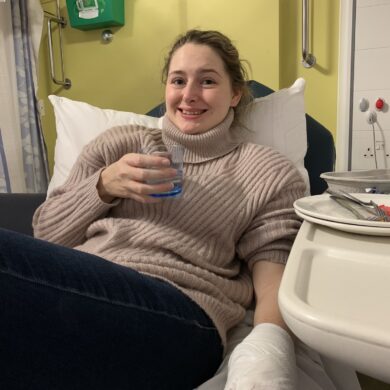
I was admitted to my local hospital, where I spent a week vomiting (being sick), going to the toilet to empty my bowels up to 15 times a day and in agony. Because this was during the COVID-19 pandemic, I was isolated and treated as if I were contagious. I was then transferred to another hospital, where doctors immediately suspected inflammatory bowel disease (IBD).
After an endoscopy and colonoscopy in March 2021, I was officially diagnosed with IBD.”
Note: An endoscopy is a thin tube with a small camera on the end inserted via the mouth, and a colonoscopy is a thin tube with a small camera on the end inserted via the back passage.

What treatment have you received for ulcerative colitis?
“Being diagnosed at 13 had a huge impact on my life. I was prescribed steroids and immunosuppressants (a medication that lowers the activity of the immune system, preventing it from attacking the body’s own cells). Side effects of steroids such as weight gain and “moon face” (a puffy, rounded face) made me self-conscious.
Six months later, the medication stopped working, and I started having regular infusions (a type of treatment given by a drip which delivers medication via the veins). It took a long time to find the right dose, and trying to study for my GCSEs alongside it made everything harder. Despite being told I might fail my exams, I managed to pass every subject.
Three years later, my treatment via infusions stopped working. In June 2025, I started a different medication, which is a type of JAK-inhibitor (these medicines reduce inflammation by blocking key pathways which cause inflammation in people with UC).”
How are you now, and can you tell us how ulcerative colitis impacts your everyday life?
“Thankfully, my treatment has been working so far, and I haven’t had a flare-up since. Living with IBD is challenging, both physically and emotionally, but it has also made me more resilient and determined.”
Is there anything you’d say to someone with digestive symptoms or conditions?
“Living with a digestive condition can be tough, especially at first, so be patient with yourself. Acceptance takes time, and you’ll get there. Your condition might shape parts of your life, but it will never take away who you are. Your story is still yours to write.”

Why are you sharing your story today?
“I want to share my story because I know how isolating it can feel to go through something like this, especially as a young person. I want others to know they don’t have to feel ashamed or alone like I did and hide their symptoms. By sharing openly, I hope to raise awareness and help others feel understood whilst breaking the poo taboo.”
Why do you want to support Guts UK charity?
“Guts UK give people with digestive conditions a voice. For conditions like IBD, they are often invisible and misunderstood. Guts UK’s work of raising awareness, providing information and funding vital research into the digestive system is so important. By supporting them, I hope to make a difference both now and in the future for others affected by digestive conditions.”
About Guts UK
Guts UK is the national charity for the digestive system and the only UK charity funding research into the whole digestive system.
People are suffering. People are dying. All because of a lack of knowledge about our guts. Guts UK exists to change that.
With new knowledge, we will end the pain and suffering for the millions affected by digestive diseases. Please consider donating today. Your donation will help fund research leading to earlier diagnoses, kinder treatments and ultimately, a cure.