Less Survivable Cancers Awareness Week
12th January to 16th January 2026
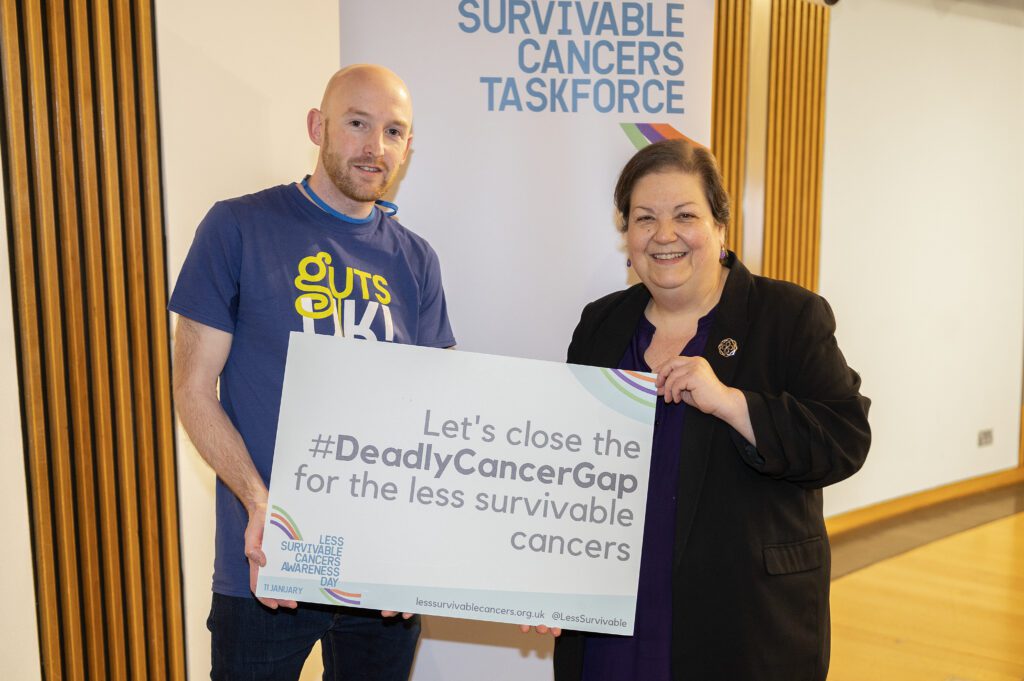
Guts UK is a founding charity member of the Less Survivable Cancers Taskforce (LSCT).
We help to raise vital awareness for the less survivable cancers – four of which are digestive cancers – and we fund life-changing research into these cancers.
What is the Less Survivable Cancers Taskforce (LSCT)?
The Less Survivable Cancers Taskforce (LSCT) represents the less survivable cancers – these are cancers of the stomach, liver, pancreas, oesophagus, lung and brain, all of which have a five-year survival rate of less than 20%. Following decades of underfunding, these cancers account for more than 42% of cancer deaths in the UK each year.
The Taskforce was set up by a group of charities aiming to double survival rates of the six less survivable cancers by 2029. Together, we call for these cancers to be prioritised in England, Scotland, Wales and Northern Ireland. Each of the charities involved supports patients who have these types of cancer, and we have joined forces to improve the outcomes and experiences of those diagnosed with a less survivable cancer in the UK.
The LSCT is made up of the following six charities: Action Against Heartburn, The Brain Tumour Charity, The British Liver Trust, Guts UK, Pancreatic Cancer UK and the Roy Castle Lung Cancer Foundation.
Our aim is to close the deadly cancer gap and raise five-year survival rates to 28% by 2029, potentially saving an extra 10,000 lives a year.
What are the less survivable cancers?
The following cancers have an average five-year survival rate of just 16%:
- Stomach
- Oesophageal
- Liver
- Pancreatic
- Brain
- Lung

What makes these cancers less survivable?
Unfortunately, these cancers are difficult to diagnose and have been neglected and underfunded for decades. Screening and programmes are limited or non-existent, and most of the general public have a dangerously low awareness of symptoms. For example, only 2% of people can identify the symptoms of oesophageal cancer and over 20% of oesophageal cancer cases are being diagnosed in emergency settings such as A&E. Unfortunately, at this stage, the cancer has often progressed to a later stage and is therefore harder to treat.
 Why is it important to raise awareness of the less survivable cancers?
Since 1971, survival for some cancers has improved by up to 87% due to increased public awareness, increased funding, research breakthroughs and enhanced treatment methods. The LSCT wants to set the less survivable cancers on the same path. As with any cancer, early diagnosis is paramount for the best chance of survival. Shockingly, the less survivable cancers account for almost half of all the cancer deaths in the UK.
Throughout the year, the LSCT works hard to change government policies to make these cancers a UK priority.
We meet with MPs nationwide to highlight the discrepancy in survival rates for these cancers and call for action. We amplify the voices and share the experiences of people living with and affected by these cancers. We raise awareness of these cancers in the media, reaching millions of people and raising awareness of the symptoms people should look out for.
Together, we must continue to share people’s stories and make the symptoms of less survivable cancers better known so people know what to look out for and when to seek help. We must and we will do better.

What is the focus for 2026’s Less Survivable Cancers Awareness Week?
Until 2025, the campaign was previously held on one day (11th January each year), but we knew that one day wasn’t enough to campaign for change.
In 2025, we started the year off with a week-long awareness campaign. To shine the spotlight on the devastating impact that the less survivable cancers have on those who are diagnosed, and their loved ones.
2026’s focus is on raising crucial awareness of the research gap between less survivable cancers and other cancers. Mark your calendars and get ready to email your MP, spread the word and help shout for change in the name of closing the research gap.
Cheryle’s story – oesophageal cancer
Cheryle’s symptoms started in April 2022. She experienced reflux and indigestion and was prescribed medication to reduce the amount of acid her stomach made. Her symptoms went away until six months later. She experienced pain when swallowing and general chest pain, and by November, it was very difficult for her to swallow certain foods. Fast forward to 6th December 2022, Cheryle received her oesophageal cancer diagnosis.

Ross’ story – hereditary stomach cancer
In 2015, Ross’ auntie was diagnosed with stomach cancer and sadly passed away in 2017. His mum was also checked for CDH1 (the stomach cancer gene) and was diagnosed with stomach cancer. She received chemotherapy and surgery to remove her stomach (a gastrectomy). After tests, Ross, and some of his other family members, found out that they also carried the CHD1 gene. In 2018, Ross had a gastrectomy. When he received the pathology results from his removed stomach, 64 pre-cancerous cells had been found.
Where can I find more information on the less survivable cancers?
Our evidence-based patient information section has information on:
The following organisations, which are part of the LSCT, have information:
- Action Against Heartburn – Oesophageal cancer information
- Pancreatic Cancer UK – Pancreatic cancer information
- Liver Cancer UK (Part of The British Liver Trust) – Liver Cancer
- The Brain Tumour Charity – Brain cancer information
- The Roy Castle Lung Cancer Foundation – Lung cancer information
How can I help?

You can help us raise vital awareness for the less survivable cancers by:
- Following us on social media and sharing our awareness and information posts during the week itself. You never know who we might reach and help together. Find us on Facebook, LinkedIn, and Instagram.
- Share an experience with a less survivable cancer with your own circles, and on your own social media channels. To submit your interest in sharing a story, please fill in and submit this form.
- Fundraise for Guts UK Charity to help us abolish the taboos surrounding digestive health, and get to grips with guts. You can fund life-changing research and empower people to seek help sooner.
- Donate £5 per month to Guts UK charity. For the price of a cuppa for you and a friend, you can change and save lives.