

Understanding patients’ experiences with microscopic colitis
Guts UK and Falk Foundation have teamed up to launch a public survey for people living with microscopic colitis.

Posted: 1st October 2019
Updated: 25th June 2024
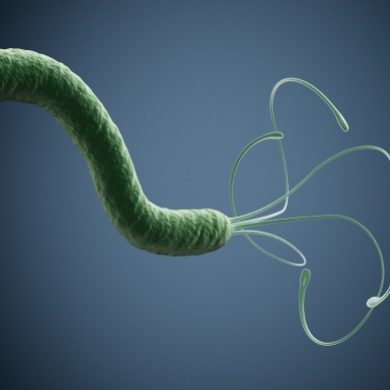
The fascinating story of the discovery of a corkscrew-shaped bacteria (helicobacter pylori) and its link to stomach ulcers and stomach cancer.
 Australian doctors Barry Marshall and Robin Warren discovered that H. pylori could lead to peptic (stomach and duodenal) ulcers. Having taken biopsies from patients with stomach ulcers and culturing the organisms in the lab, the doctors discovered the bacteria and its link to stomach ulcers following a clinical trial with 100 patients in 1982.
Stomach ulcers were previously thought to be due to stress or lifestyle factors, and when Marshall & Warren discussed their findings with the medical community, they were met with scepticism and criticism. They struggled to make their case and their attempts to infect animals with the bacteria hadn’t worked.
Marshall took matters into his own hands and cultured the bacteria from a patient with gastritis. He treated the patient with antibiotics and confirmed the infection was gone. But that wasn’t all…
Marshall drank the organisms himself in a “cloudy broth” the following morning. He vomited for days and felt generally unwell. After 10 days, his endoscopy confirmed that the bacteria were everywhere and gastritis had developed.
Marshall & Warren’s work was debated by gastroenterologists across the globe about for around 10 years after it was first published. It wasn’t until a PR company came across the research and published it as a mainstream story that interest in the pair’s work built.
 The pair battled for years for this phenomenon to be accepted by the international medical community. In 2005, Marshall and Warren’s work was finally recognised. The pair were awarded the Nobel prize in Physiology for their pioneering work.
Click here to read our expert information about Helicobacter pylori.
We’re still discovering just how influential our microbiome (gut bacteria) is; not just for our digestive health, but impacting upon our entire body. We need more research to solve the mystery surrounding the bacteria in our guts.
Please support Guts UK. Together, we can get to grips with guts!





Guts UK and Falk Foundation have teamed up to launch a public survey for people living with microscopic colitis.
Peter told us how he’s always had digestive symptoms, such as bloating, and that no one could really work out what was causing it. He also experienced heartburn and indigestion. 12 years ago, an endoscopy...
By submitting this form, you are consenting to Guts UK contacting you by email as detailed above. To make any changes to your preferences you can email us on info@gutscharity.org.uk or by calling us on 020 7486 0341. Your details are safe with us. Please read our Privacy Policy for more details.