
Finding ways to prevent severe acute pancreatitis
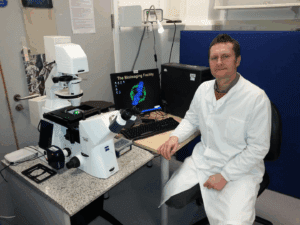
For some people with acute pancreatitis, their condition can become life-threatening, but we have no way of stopping this. In a Guts UK-funded project, Dr Jason Bruce and his team are studying the link between acute pancreatitis and bowel inflammation. Find out how this could one day prevent severe pancreatitis and help save lives.
Acute pancreatitis is a condition where the pancreas becomes inflamed and damaged, causing severe pain, nausea, and jaundice.
For most people, the pancreatitis gets better on its own after a few days in hospital. But for one in five patients, their pancreatitis becomes severe, which can lead to sepsis and multiple organ failure. Sadly, up to 40% of people in this situation will die as a result.
The only treatment option for severe acute pancreatitis is to control symptoms, relieve pain, and provide nutritional support via a feeding tube, often during prolonged periods in intensive care.
“Other than that, there’s really nothing that can treat the disease,” says Dr Jason Bruce, who studies pancreatitis at the University of Manchester. “It’s literally just hope and pray that this management of the symptoms will eventually allow the patients to recover.”
We need treatments that can prevent acute pancreatitis from getting worse. Guts UK is funding a project led by Dr Jason Bruce which could one day provide such a treatment.
And the idea for this project came from an unexpected discovery Dr Bruce made while studying the link between pancreatitis and diabetes.
Insulin the protector
The pancreas is mostly made up of acinar cells, the cells that secrete digestive enzymes into the gut, and where pancreatitis originates. The pancreas also contains cells that produce hormones, including the β-cells that secrete insulin into the blood.
It’s already known that a person’s risk of developing severe pancreatitis increases if they also have diabetes – either when the pancreatic β-cells do not produce enough insulin (type-1), or the body doesn’t respond to insulin properly (type-2).
Dr Jason Bruce and his team previously studied this link and showed that insulin, normally secreted from β-cells, protects the acinar cells from injury.
To show this, they used two types of genetically engineered mice. The first were diabetic mice which couldn’t produce insulin. In the second type of mice, called PACIRKO mice, the acinar cells lacked insulin receptors, making these cells unresponsive to insulin.
Dr Bruce and the team found both diabetic and PACIRKO mice develop severe pancreatitis, proving that this was caused by the loss of insulin no longer protecting the acinar cells. This explains why people with pre-existing diabetes may be more vulnerable to severe pancreatitis. It also suggests that collateral injury to the β-cells during pancreatitis reduces insulin and the protection it gives to the acinar cells, leading to more severe pancreatitis.
A surprising gut discovery
But Dr Bruce noticed something unexpected about these PACIRKO mice, the ones that lacked insulin receptors in acinar cells: they also show signs similar to inflammatory bowel disease (IBD).
As well as secreting digestive enzymes to help digest food, pancreatic acinar cells also secrete natural antibiotics called antimicrobial peptides or AMPs into the gut. AMPs help keep a healthy balance between the ‘good’ and ‘bad’ bacteria in the gut. If this balance tips in favour of ‘bad’ bacteria, this can lead to inflammation and a loss of mucus barrier, and the bacteria can leak out of the gut.
Dr Bruce and his team found that in the PACIRKO mice, there is also a loss of production and secretion of AMPs from the pancreas into the gut. This led to overgrowth of ‘bad’ bacteria, an inflamed bowel, and reduced mucus secretion – all early signs of the gut becoming leaky to bacteria.
Dr Bruce’s surprising findings in PACIRKO mice confirmed anecdotes he had heard from both doctors and patients, that pancreatitis and bowel problems often go together. “I think that just reinforced our idea that this might actually be a real phenomenon [in humans] – not just something odd about these mice,” he explains.
Breaking the three-way link
Dr Bruce’s theory is that there is a three-way link between pancreatitis, loss of insulin secretion, and gut inflammation – creating a vicious cycle that leads to severe pancreatitis.
Pancreatitis damages acinar cells but also causes collateral damage to the β-cells. This reduces insulin secretion, which removes the protection from the acinar cells and makes pancreatitis worse. The loss of insulin also reduces the secretion of AMPs into the gut, allowing the ‘bad’ gut bacteria to grow out of control and ‘good’ bacteria to become depleted. This leads to gut inflammation, loss of mucus barrier and eventually, the bacteria leak out of the gut and into the blood. This makes the pancreatitis even worse, and eventually leads to sepsis and multiple organ failure that is so often seen in severe pancreatitis.
But he thinks that AMPs might hold the key to preventing this vicious cycle. Delivering AMPs directly to the gut, via a feeding tube, at the first signs of the pancreatitis becoming severe might keep the bad gut bacteria in check. This would protect the gut from becoming leaky to bacteria and prevent the escalation to more severe pancreatitis.
“Everybody that I speak to, whether they are a basic scientist or a clinician, they’re very excited about this idea,” he says.
Guts UK is funding a PhD student in Dr Jason Bruce’s team to test whether administering AMPs to the gut in their ‘diabetic’ and PACIRKO mice will reduce the severity of pancreatitis. If successful, this research could eventually lead to a trial testing early administration of AMPs via a nasojejunal feeding tube as a treatment in patients with acute pancreatitis.
Dr Bruce’s hope is that, at the first warning signs that a person is going to develop severe pancreatitis – possibly that drop in insulin secretion – early treatment with AMPs might prevent the escalation to life-threatening disease. This would reduce the time they spend in intensive care and speeding up their recovery.
“The closest we’ve been to making an impact on patients’ lives”
Pancreatitis has not received much research investment in the past. This is despite the huge personal cost for people affected, and the significant healthcare cost of looking after them in intensive care – an estimated £200 million in the UK, and $2.6 billion in the USA, every year.
According to Dr Bruce, Guts UK is “one of only two or three funders that fund pancreatitis research.” And this Guts UK project has the potential to benefit people very soon.
“In all of the projects I’ve worked on so far, this is the closest that we have been to making an impact on patients’ lives,” Dr Bruce says. “I can literally map out how this might work over the next 5 to 10 years.
“And therefore, this funding is absolutely critical. It’s not just funding blue-sky research. It’s funding a basic science project that is likely to have real impact in the very near future.”
Find out more about ‘Kranky Panky’, our pancreatitis awareness month campaign, and how you can support scientists like Dr Jason Bruce to find treatments for acute pancreatitis.