NICE Guidelines on Pancreatitis Diagnosis and Management
Posted: 14th March 2018 Updated: 27th March 2018
Pancreatitis is an important condition for Guts UK, and a key area of research for our organisation. NICE (The National Institute for Health and Care Excellence) is a non-departmental public body responsible for providing national guidance and advice to improve health and social care.
Have Your Say
NICE is currently developing new guidelines for the diagnosis and management of pancreatitis as part of an ongoing consultation with relevant stakeholders. Guts UK is a stakeholder and we are keen to collect comments on the draft guidelines, as well as any other feedback, from people affected by pancreatitis, including patients, their families and their carers.
NICE accepts comments directly from individuals but it encourages individuals to submit their comments through a registered stakeholder organisation wherever possible. Find out how to comment on these guidelinesor contact Guts UK at [email protected] to pass on your comments to us, or for any queries.
The consultation closes on 25 April 2018 at 5.00pm. Expected publication of the guidelines is the 5th of September 2018.
Pancreatitis
Grace and Kirsty speaking at the GBIHPBA annual surgeons conference.
Adding a powerful patient voice, Guts UK supporters Kirsty Donaldson and Grace Chatten recently spoke at the GBIHPBA annual meeting, a conference for liver, pancreas and bile duct surgeons. You can read Kirsty’s story about living with chronic pancreatitis here.
Pancreatitis is an inflammation of the pancreas, a large gland found behind the stomach. The pancreas produces digestive juices (enzymes that break down food into nutrients) and hormones such as insulin, the molecule responsible for controlling blood sugar levels. Pancreatitis can be acute or chronic. In acute pancreatitis the inflammation flares up suddenly, causing some of the digestive juices to damage the pancreas and sometimes the tissues around it. In chronic pancreatitis, ongoing inflammation causes scarring, thickening, and other damage to the pancreas. This can lead to problems with the digestion of food and to diabetes. Both acute and chronic pancreatitis can be extremely painful.
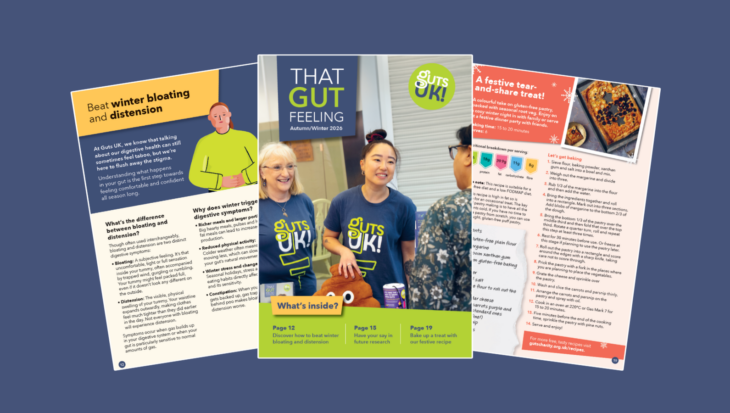
The latest edition of That Gut Feeling, our bi-annual magazine, has arrived! Our Autumn/Winter 2026 magazine is jam-packed with the latest news, information, real-life stories and campaigns from Guts UK. From helpful guides on managing...
As a Trustee of Guts UK, Linda wanted to do something to support the charity while bringing her family together at Christmas. Taking part in an organised Santa Dash, ‘Santa in the City’ gave her...
did you know your guts are 25ft long?! sign up for more fascinating facts, the latest research developments and how you can support further, including fundraising activities and more:
Footer - Newsletter Signup
DID YOU KNOW YOUR GUTS ARE 25FT LONG?! SIGN UP FOR MORE FASCINATING FACTS, THE LATEST RESEARCH DEVELOPMENTS AND HOW YOU CAN SUPPORT FURTHER, INCLUDING FUNDRAISING ACTIVITIES AND MORE:
By submitting this form, you are consenting to Guts UK contacting you by email as detailed above. To make any changes to your preferences you can email us on [email protected] or by calling us on 020 7486 0341. Your details are safe with us. Please read our Privacy Policy for more details.