
Developing a targeted treatment for acute pancreatitis
Posted: November 2026
Besides supportive care, there is little that doctors can do for people if their acute pancreatitis gets worse. But that could soon change – thanks to research that began with Guts UK funding. Learn about how your donations could lead to a treatment that will help people recover quicker, saving lives.
The risks of severe acute pancreatitis
Around 30,000 people in the UK every year are affected by acute pancreatitis, starting with symptoms like extreme abdominal pain and sickness. Though most people recover after a few days in hospital, about one in five patients develop life-threatening complications.
The deadliest of these potential complications is either early organ failure or that the pancreas starts to die – a process called necrosis. This itself sparks a wildfire of inflammation throughout the body, which can end in multiple organ failure, and sometimes death.
When Mr Rajarshi (Rishi) Mukherjee was training to become a surgeon, he remembers treating pancreatic necrosis – with his hand inside patients’ abdomens, clearing away dead tissue, to try to limit the damage. “I thought, ‘This is quite barbaric – surely, there must be better ways of managing patients?’” he says. “That really got me interested in acute pancreatitis.”
Despite the number of people affected, and how serious the disease can get, there are no specific treatments available for pancreatitis, beyond pain control, fluids, and other supportive care. As a result, someone in the world dies from pancreatitis every five minutes.
A targeted treatment specifically designed for acute pancreatitis would be a breakthrough. Such a treatment would help more people to recover quicker, reducing complications like necrosis and organ failure, ultimately saving lives.
And thanks to early research supported by Guts UK, we may see a treatment for acute pancreatitis reaching clinical trials soon.
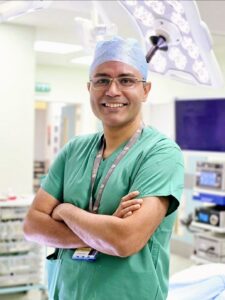
Image of Mr Rajarshi (Rishi) Mukherjee
Cyclophilin D
Rishi’s interest in pancreatitis led him to the University of Liverpool to work with pancreatitis expert Professor Robert Sutton. There, during his PhD, Rishi would zoom in to look at what is happening inside cells during necrosis.
Professor Sutton and Rishi were interested in mitochondria – the ‘power plants’ which produce the energy the cell needs. They were focussed on a structure called the ‘mitochondrial permeability transition pore’, or MPTP.
When the cell is damaged, such as during pancreatitis, the MPTP punches a hole in the mitochondria, setting off a chain of events which lead to necrosis. Rishi and Professor Sutton thought that blocking the MPTP could protect the mitochondria – and perhaps stop inflammation and necrosis, and ultimately the catastrophic problems they can cause.
So in 2007, Guts UK awarded the Amelie Waring Fellowship to fund Rishi to investigate the role of the MPTP in acute pancreatitis. And in this project, he found that one of the molecules that controls the pore, called cyclophilin D, was crucial.
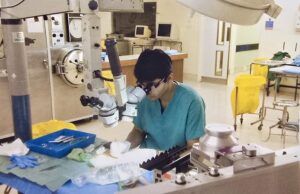
Image of Rishi Mukherjee during his Guts UK Amelie Waring Fellowship
Rishi and his colleagues showed that blocking cyclophilin D protected the mitochondria and stopped necrosis, in both animal and human pancreatic cells in the lab. The team also showed that blocking cyclophilin D significantly reduced inflammation and the overall severity of pancreatitis, in mice with the disease.
So Rishi’s research showed, for the very first time, that cyclophilin D could be a target for a drug for acute pancreatitis – a potential breakthrough for patients.
"My Guts UK Amelie Waring fellowship was the first time anyone had ever looked at the role of cyclophilin D in pancreatitis...and was pretty seminal in the whole journey we’ve been on since."
Mr Rishi Mukherjee
Testing new potential drugs
The next step was to test some potential small drug-like molecules that block cyclophilin D, which could become a future treatment.
This work was carried on by Mr Muhammed Ahsan Javed, another academic surgeon in Liverpool supported by the Guts UK Amelie Waring Fellowship in 2011. Like Rishi, Ahsan was inspired by patients he treated during his medical training.
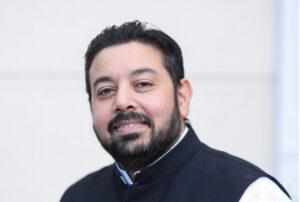
Image of Mr Muhammad Ahsan Javed
“As a trainee, I used to admit patients with pancreatitis who were in a lot of pain,” Ahsan recalls. “I knew that 20% of them are going to have a very bad clinical course, but apart from giving them painkillers and fluids, I had no other treatment options.”
During his Guts UK-funded work, Ahsan tested a group of potential cyclophilin D blocking drugs that had already been developed. Ahsan’s work showed that better cyclophilin D blockers were needed, and pointed the team in the direction to develop new drugs.
Widening the therapeutic window
Rishi and Professor Sutton then worked with medicinal chemistry colleagues in the University of Liverpool to develop better cyclophilin D inhibitors. The team are now getting these drugs ready to test in clinical trials.
Part of this work means knowing exactly what stage of the disease these drugs would be most beneficial. And that has involved yet another Guts UK Amelie Waring Fellow in Liverpool, Dr Arjun Kattakayam.
Arjun’s research has showed that blocking cyclophilin D is not just beneficial in the pancreas, but also outside it as well, and can reduce the body-wide inflammation and organ damage caused by pancreatitis.

Image of Dr Arjun Kattakayam
These findings are great news, as they suggest that cyclophilin D inhibitors could still be helpful even if their pancreatitis is already severe, or to stop further organ failure if necrosis of the pancreas has already started.
“Even after the horse has bolted out of the stable, if you have a drug that could still impact crucial events that are ongoing […] it widens the therapeutic window,” says Rishi, who has been supervising Arjun in his work.
The influence of people affected by pancreatitis
The day-to-day interactions Rishi, Ahsan, and Arjun have with patients have deeply influenced their research. “Every innovation starts with understanding a problem, and there’s no better way to understand a problem than to talk to patients,” says Rishi.
And it’s the charity’s connection to patients, and its willingness to back medical professionals as they develop their scientific research, that he believes makes Guts UK stand out. “I think to have the highest impact, and to deliver that change, you need to have a charity backing research and innovation like Guts UK does.”
“None of this would be possible without Guts UK”
There’s still a long road ahead to get the cyclophilin D inhibitors ready to test in people. But Rishi and his team at the University of Liverpool have recently received further funding to take the next step in the journey. He believes the first clinical trials could be possible “in the next three to four years.”
If these trials are successful, cyclophilin D inhibitors could become the targeted treatment we’ve been hoping for – helping people recover quicker and saving lives. “In terms of impact for acute pancreatitis, it could be game-changing.”
And Rishi says his Guts UK funding – as well as our funding for Ahsan’s and Arjun’s work – has been fundamental.
“It’s been amazing...if I go back and consider this voyage of discovery, none of this would be possible without Guts UK – not just input right at the beginning, but continued input throughout.”
Mr Rishi Mukherjee