June 2026 update: How to deal with Creon, Nutrizym or Pancrex supply issues

Overview

Issue date: 2nd June 2026 (Version 7). 

The most up to date advice can be found on the Pancreatic Society of Great Britain and Ireland (PSGBI) website, the correct version of this document is version 6: https://www.psgbi.org/position-statement-pert-shortage/.

If you would like a printed copy, you can e-mail us at info@gutscharity.org.uk or call us on 0207 486 0341. 

Advice for children and those with cystic fibrosis (CF)

Note that this advice is for adults with PEI. For children with PEI, specialist advice should be sought. People with cystic fibrosis will be cared for at a specialist centre. Some advice in this leaflet is not suitable for them, and we’ve highlighted this. If you have CF you should contact your specialist team if you have any concerns.

Advice for those with (non-pancreatic) neuroendocrine neoplasms treated with somatostatin analogues 

Somatostatin analogues are the medicines Lanreotide (Somatuline®)/Octreotide (Sandostatin®). Contact your specialist centre if your symptoms keep getting worse or if you have any concerns. They may refer you to a pancreatic centre for advice on managing your enzymes.

An illustration of a person collecting medication from a pharmacist.

Introduction  

Please note that this document has been updated due to the availability of imported alternatives to Creon®, Nutrizym®, and Pancrex®. Everyone should now be able to get the enzymes they need but they might be a different brand.

Pancreatic enzyme replacement therapy helps people with pancreatic exocrine insufficiency (PEI) digest food properly. This condition often arises from:

  • Pancreatic cancer
  • Pancreatitis
  • Pancreatic surgery
  • Cystic fibrosis (CF)
  • Neuroendocrine cancers

Many other clinical situations can cause primary or secondary PEI. These include: 

  • Gastrectomy (stomach removal surgery) or gastric bypass surgery.  
  • People who take the medicine somatostatin analogues like Lanreotide (Somatuline®) or Octreotide (Sandostatin®) for neuroendocrine neoplasms (NENs) are also at risk of PEI.

Regardless of the cause of the PEI, the types of symptoms and their severity will vary from person to person.

The current supply problems with pancreatic enzyme replacement therapy (PERT) under the brand Creon® will probably last until the end of 2026. Some people will need a different brand of PERT, like Nutrizym® or Pancrex®, due to current supply issues. This advice is for everyone who takes PERT.

Guts UK's female brand character is stood up, clutching her stomach, in pain, with a sad expression

Current supplies

  • Creon® 25,000 is available in capped amounts.
  • Creon® 10,000 comes in capped amounts. It should prioratised for babies, infants, and anyone who can’t swallow or open capsules.
  • Nutrizym 22® is sometimes available, but it can’t meet high demand. It should be prioritised for those who can’t tolerate Creon.
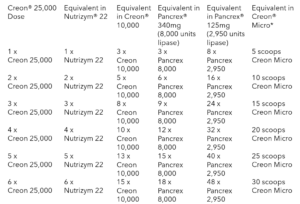
  • Pancrex® capsules are available, but unable to meet the increased demand. Please see Table 1 below to help you calculate your dose if you are prescribed this.
  • Pancrex® powder isn’t for taking by mouth. If you get a prescription for it, don’t pick it up from the pharmacy. Once you collect it, it can’t be reused. This product is used by people who have a feeding tube.

GPs and pharmacies have received information on how to order imported medicines like Pangrol® to fill the supply gap. These should be ordered for anyone who may run out of PERT.

Symptoms of untreated or poorly treated PEI can include:

  • Bloating
  • Excess wind
  • Diarrhoea
  • Crampy tummy pain
  • Urgency to open bowels
  • Steatorrhea (pale floating stools)
  • Difficulty managing blood glucose levels
  • Vitamin and mineral deficiencies
  • Weight loss
  • Malnutrition

These symptoms are usually treated by taking PERT and will recur if you are unable to take enough.

We have divided the advice for patients into 3 phases, depending on the supply available.

  • Stage 1: What to do when you have a supply.
  • Stage 2: What to do if you think you need to increase your dose.
  • Stage 3: What to do if you have less than two weeks supply left.

Stage 1: What to do when you have a supply

Please don’t stockpile these medicines while the supply issues continue. This will only worsen the shortage.

The Department of Health and Social Care recommends issuing only a 1month supply at a time to help regulate supplies. If you currently get 2 to 3 months of your PERT at once, you’ll need to collect your prescriptions more often. If you pay for your prescription, think about getting a pre-payment certificate. This can help lower your prescription costs.

Requesting your prescriptions:

  • We suggest you place your prescription requests as soon as you have picked up your last prescription. This should give the community pharmacist time to source your medication.
  • It is important that you check with your GP surgery that the prescription request has been authorised. Some GP surgeries have an automated system that rejects repeat prescriptions if they are placed too early.
  • If you still receive a paper prescription. Ask for your PERT prescription on a single script. This lets you switch pharmacies easily if needed. It won’t interfere with your other medications.
  • Talk to your GP and pharmacist about the shortage. Let them know you might need an imported medicine if your PERT isn’t available.

The following advice will make your PERT as effective as possible:  

  • Remember to store your PERT appropriately. All PERT should be stored below 25 degrees, and some brands recommend refrigeration.
  • If PERT gets too hot it does not work properly, this damage cannot be reversed.
  • Taking the PERT during the meal, rather than all at the start, middle, or end, helps digest the food and drinks better.
  • Ensure that you use your PERT before it goes out of date. If you store PERT in different places (i.e. at work), make sure you rotate your supplies to prevent any wastage.

Stage 1 summary:

Please make sure you: 

  • Use your PERT as effectively as possible (store it correctly, make sure it does not go out of date)
  • Put your next prescriptions in as soon as your previous one has been dispensed
  • Check that each prescription has been approved by your GP surgery
  • Do not stockpile PERT – this makes the whole situation worse.
  • Talk to your GP and pharmacist about getting imported medications. This way, you’ll be ready if you have less than two weeks’ supply left.

Stage 2: What to do if you think you need to increase your dose

Sometimes people may need to increase the amount of PERT they take as time goes on. You might need to increase your dose if:

  • You’re new to PERT and your symptoms aren’t under control
  • If your bowel symptoms worsen as your appetite improves.

If you have cystic fibrosis – please contact your specialist centre. 

Before increasing your dose, please check you are using your PERT as effectively as possible: 

If you are not already taking one talk to your doctor about taking a proton pump inhibitor like:

  • omeprazole® 
  • pantoprazole® 
  • lansoprazole® 

Or a (H2)-receptor antagonist like : 

  • famotidine®  
  • nizatidine® 

These medicines lower stomach acid and help the enzymes work better. This means a dose that is lower than your usual dose may be effective if you have a proton pump inhibitor as well. If this does not appear to be effective, they may be stopped. This may not be appropriate for everyone.

Make sure to space your PERT dose with your meals, unless told otherwise. Your advice might change if you have conditions like gastroparesis or delayed gastric emptying.

Ensure your PERT does not get too hot – it needs to be stored below 25 degrees. Make sure it is not left in the car on a sunny day, left in direct sunlight, on a radiator in a warm pocket or close to an oven or kettle.

Please reach out to your dietitian, nurse specialist, or doctor if you have malabsorption symptoms or are losing weight regularly.

Advice for people taking nutritional supplement drinks 

If you take oral nutritional supplements, for example:

  • Altraplen®
  • Aymes®
  • Ensure®
  • Foodlink®
  • Fortisip®
  • Fresubin®

Your GP or dietitian may ask you to change these to peptide / semi-elemental preparation for example:

  • Vital 1.5kcal®
  • Survimed OPD 1.5kcal®
  • Peptisip Energy HP®

as most people can manage these without additional enzymes.

These do not come in a wide range of flavours, but you can add milkshake syrups or coffee syrups to increase the range of flavours. Serve them chilled or freeze them into ice lolly moulds or ice cube trays to give you more options.

You might be advised to try protein or fat-free nutritional supplements like:

  • Actagain Juce®
  • Altrajuce®
  • Ensure Plus Juice®
  • Fortijuce®
  • Fresubin Jucy®

Sip these slowly. This helps your gut digest them better without PERT. Check your blood glucose levels closely if you have diabetes while taking these.

If you feel bloated, don’t worry. This is normal when taking these without PERT. But if it affects your quality of life, tell your dietitian.

Stage 3: What to do if you have less than two weeks supply left

Do not worry – Primary Care have made plans to reduce the risk of anyone running out.

There are plans to ensure PERT is available for everyone. However, many medications are currently in short supply. Your GP or local pharmacist might not know about the advice available within their area. They may need to contact their medicines management team to access this advice.

There are 3 steps for you to do if you have less than 2 weeks supply left and your pharmacist is not sure if any more will come in time.

  1. Check with the manufacturers customer support team to see if there is a supply near you.
    • Creon: call 0800 8086410
    • Nutrizym: call 08000 902408 (Mon-Fri 9-5)
  2. Speak to your GP about a prescription for an alternative product (see Table 1 below). Talk to your GP and pharmacist about getting a prescription for one of the imported medications available in the UK to help with supply issues. There is a more complicated process to access these, so don’t leave this discussion until the last minute. If you are seeing your GP for another reason, explain the issues when you see them. Ask if you can have a prescription for the imported medicines in case you are unable to source any PERT. Make sure your pharmacist is aware so they can check with their local medicines management teams how they can access this stock for you. The most common imported medicines are Pangrol® or Kreon® / Creon® from Germany or Canada.

If you have completely run out, please make an emergency (same day) appointment with your GP. You can show them this document. They can access advice for health care professionals here: https://www.psgbi.org/position-statement-pert-shortage/.

If you have diabetes and take medication to lower your blood glucose, it’s important to check your levels regularly. Without PERT, you could experience low blood glucose.

If you are under the care of a local hospital, please contact your local hospital team and ask for a rescue prescription. This will only cover a short time and does not replace the use of an imported medicine for you. Hospitals no longer receive priority for ordering stock of PERT, so this may not be possible.

Table 1 Dose calculations to use if you are prescribed an alternative product.

*Mix with a mildly acidic puree (fruit yoghurt / apple sauce), rinse mouth with water and ensure thorough mouth care as at risk of ulceration if powder / granules get stuck in the gums / under dentures

Getting support

Guts UK

Here at Guts UK Charity, we support people with pancreatitis and pancreatic exocrine insufficiency. This includes pancreatic exocrine insufficiency caused by stomach surgery and diabetes. We’re open Monday to Friday, 9am to 5pm. For information, you can call us on 020 7486 0341 or email us at info@gutscharity.org.uk.

Pancreatic Cancer UK

Cystic Fibrosis Trust

Neuroendocrine Cancer UK

  • twitter
  • facebook
  • linkedin
  • youtube
  • tiktok
  • instagram

Read more posts...

Magda’s gastritis story

Magda describes her gastritis symptoms as being like someone is inside her stomach with a razor blade, pouring acid onto it. Keen to raise awareness and funds, Magda shares her story and fundraising challenge to...

A close-up, eye-level shot of a smiling woman resting her arms on the tiled edge of an indoor swimming pool. She is wearing a pink and black swim cap, dark goggles resting on her forehead, a purple swimsuit strap, and a thin beaded necklace and bracelet. The background shows the clear blue water of the pool lanes divided by orange and black floats, under an indoor ceiling with hanging yellow and dark pennant banners.